The usual take: agents type faster than us. The interesting one: they don't need our hours. The repo exists 24/7; you attend to it ~8h a day. A good harness isn't a faster keyboard — it's a scheduler that fills the dead hours.
The repo runs longer than you
8h/day × 22 working days ≈ 176h of attention a month. The repo runs 720. Three quarters of the time your most expensive artifact does nothing — and idle isn't neutral: deps drift, tech debt stacks up, Friday's bug sits until Monday. A harness that only runs while you run inherits all of that.
Scheduled agents, non-colliding intervals
An agent preset with a scheduler — interval, goal, loop cap — on a remote machine, pointed at the project. One safety rule, same as everywhere in Spectral: one active agent per project. So the night is split into lanes that never overlap:
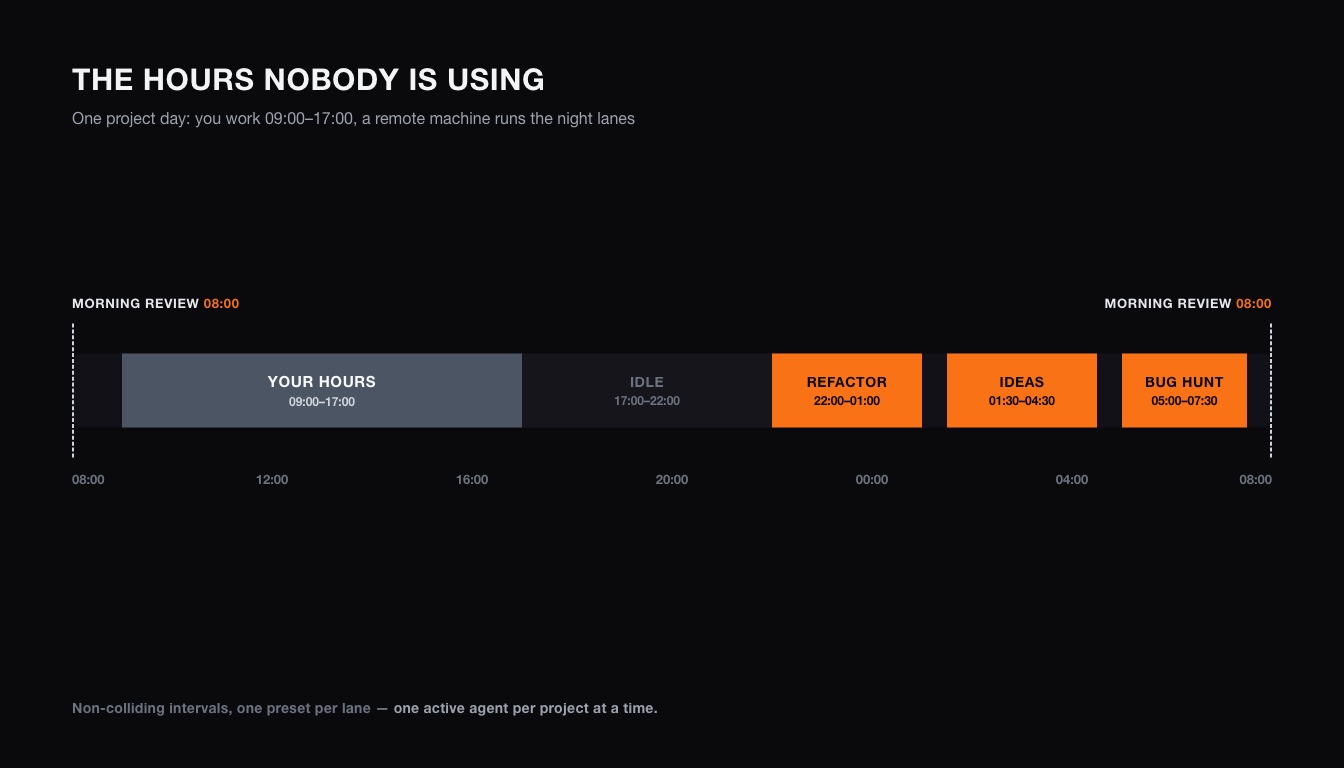
- Refactor, 22:00–01:00 — mechanical refactors, always on a branch
- Ideas, 01:30–04:30 — feature proposals as well-described tasks
- Bug hunt, 05:00–07:30 — fixes on separate branches
Each lane finishes before the next starts, so no two agents touch the same files. Everything waits behind one barrier: your morning review.
What the lanes ship
Refactor = cheaper future sessions. Boring on purpose: honest file names, oversized files split, tree-like folders, dead code gone. Agents navigate by grep + structure, and cross-session memory works better when a fact lives in one place — so a 23:00 refactor makes every next session cheaper. Compound interest.
Ideas = tasks, not commits. The agent reads docs, issues, the code, and drafts features into the Ideas column of the project board: scope, touched files, done-criteria. Morning-you triages — promote, edit, drop.
Bug hunt = branches, never main. A flaky test at 05:00 becomes a fix on its own fix/* branch with a reviewer report attached. Morning: read the diff, rerun the tests, merge or kill. Isolated fixes mean a bad night costs minutes to undo, not a broken build.
The math
Agents work only when you don't:
| Who works | Schedule | Hours/month |
|---|---|---|
| You | 8h × 22 working days | 176h |
| Weekday nights | 16h × 22 days | +352h |
| Weekend nights | 16h × 8 days | +128h |
Your day leaves 16h — 2× your time, every working day. Add weekends and the night contributes 480h on top of your 176: 656h total, ~3.7× a solo month.
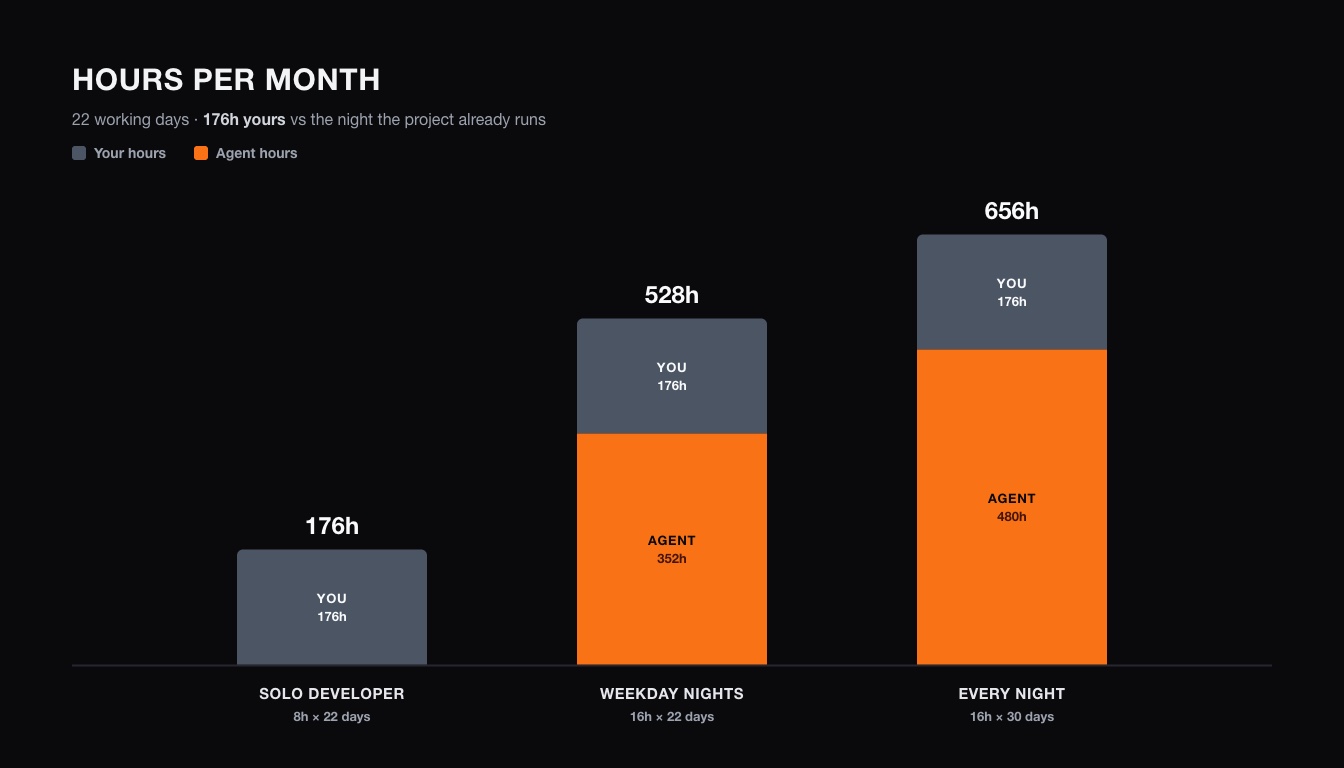
Agent-hour ≠ your-hour: agents are slow on judgment, fast on mechanics, and subagents run in parallel. With well-chosen queues and a real morning review, 2–3× more shippable work per month is realistic. The 352h already exist though — you're paying for them and getting nothing back.
Guardrails
Scheduled agency without guardrails is automated noise:
- Bounded jobs only — a described scope, never "improve the project"
- Own branches, never main — a night that can't break the build is a night you sleep through
- Nothing merges unread — every morning is a review barrier
- Non-colliding intervals — one agent per project, lanes serialized like waves
- Stop conditions — loop caps + explicit goals, so a stuck agent stops before sunrise
Takeaways
- 720h repo, 176h you. A good harness moves work into the difference.
- Lanes, not one big agent. Each gets its own interval, never colliding.
- The night ships branches and tasks, not merges. Refactors and fixes on separate branches; ideas into the Ideas column.
- Every morning is a barrier. Review, then let it run again. Trust is scheduled, not assumed.