Spectral keeps a cross-session memory of your project: small, durable
observations written down when a session ends, queryable with
read_project_observations before the next session touches any code. For a
long time that memory had an embarrassing secret — you could only find things
in it by exact substring. The tool's own description used to apologize for it:
"Uses simple substring matching — be specific with your query terms."
We rebuilt the search underneath it: n-gram indexing, ranked scoring, typo tolerance, and near-duplicate detection on the write side. No new dependencies, no embedding service, no vector database.
The failure you've probably hit
A session in March writes:
Prisma migrations live in
backend/prisma/migrations— rollback withprisma migrate resolve, never by hand.
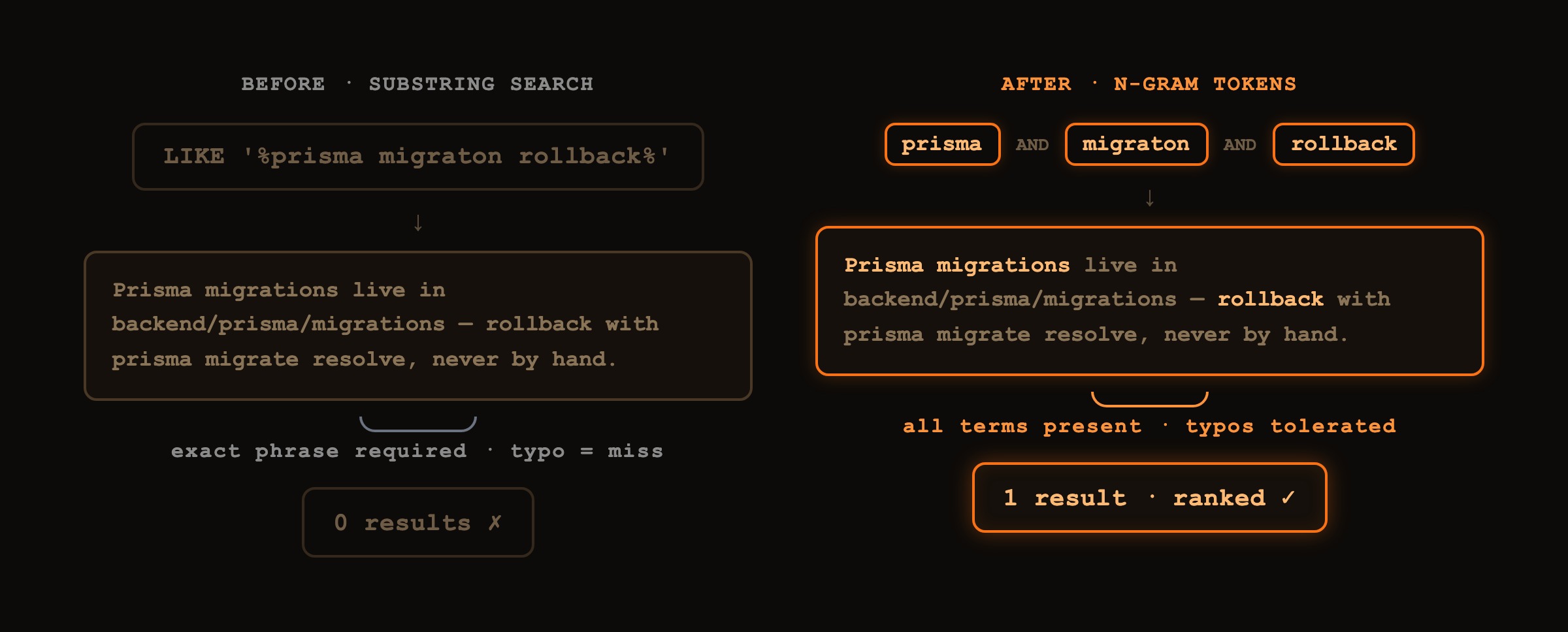
Two weeks later the agent asks its memory: "prisma migrate rollback". The old
search ran:
WHERE content LIKE '%prisma migrate rollback%'
Every word is there; the exact phrase is not. 0 results — and the agent
hand-edits a migration, the exact mistake the memory existed to prevent. One
letter off is just as dead: "migraton" returned nothing too.
Trigrams: substring search you already ship
Agent queries are natural-language fragments, not phrases — so the right
semantics is an AND of query tokens, ranked, with typo tolerance. The trick
is an old one: an n-gram index with n = 3. FTS5 ships a tokenize='trigram'
option inside the SQLite builds Spectral already uses, so the whole feature is
one virtual table:
CREATE VIRTUAL TABLE project_observations_fts USING fts5(
  content, project_id UNINDEXED, obs_id UNINDEXED,
  tokenize='trigram'
);
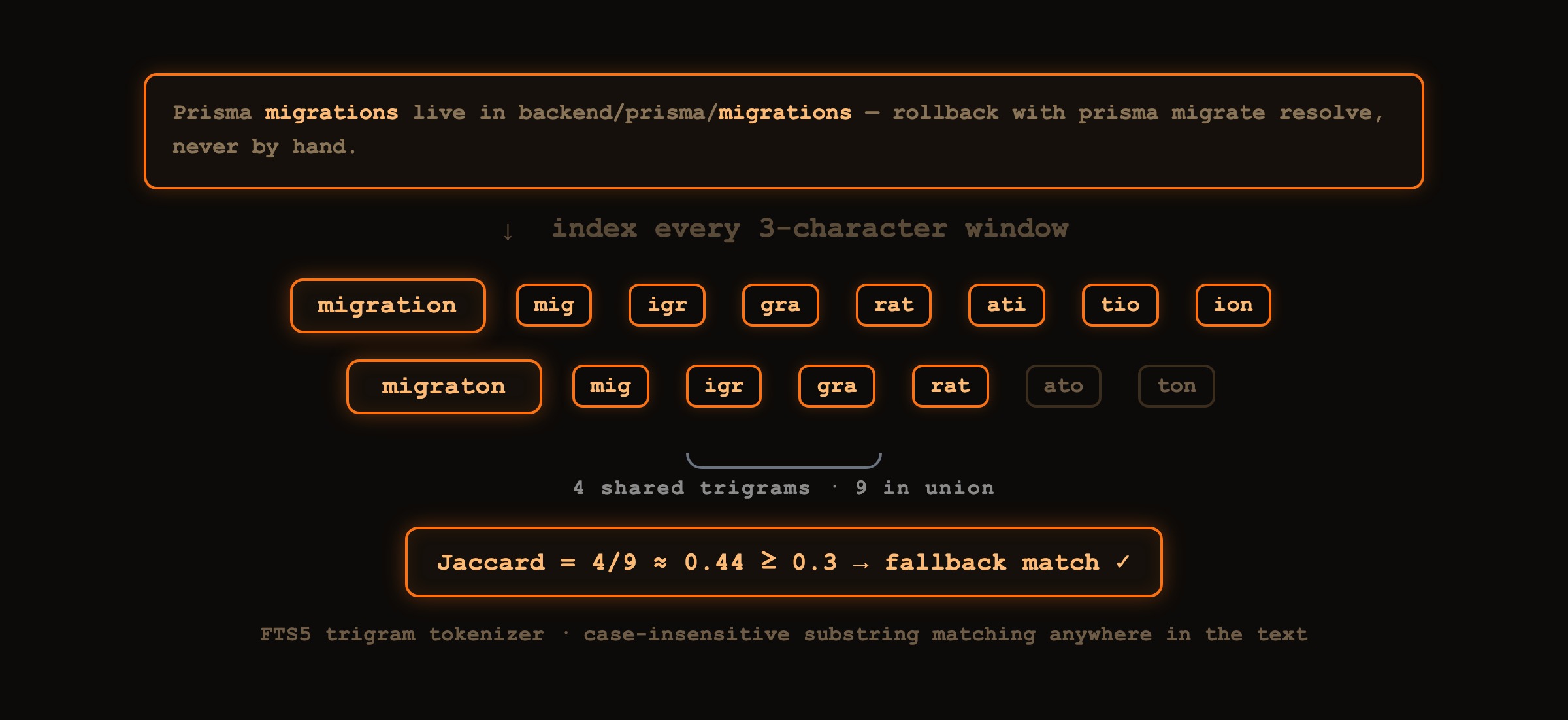
Every 3-character window gets indexed, so any substring becomes findable —
including mid-word matches that broke plain full-text search for code
identifiers. The index is synced in the same transaction as every write and
backfilled on open, so it can never drift from the rows. A query becomes
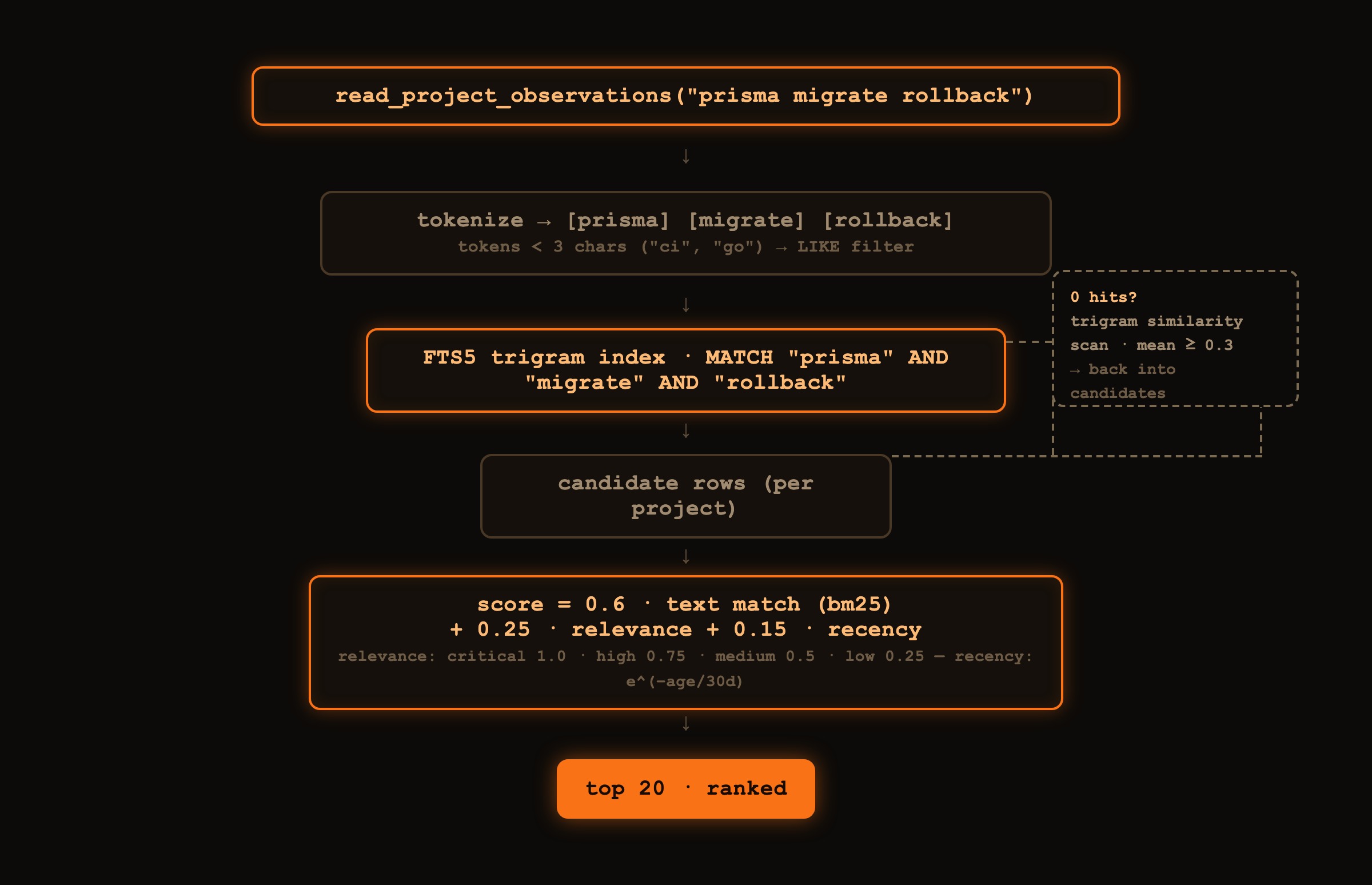
MATCH '"prisma" AND "migrate" AND "rollback"': case-insensitive substring
matches in any order, any position. Sub-3-character tokens fall through to a
plain LIKE filter with the same semantics.
Rank, don't just list
Finding 20 rows is easy; ordering them is what makes the agent trust the tool. The old search sorted by date. The new one scores:
score = 0.6 × text match (bm25)
      + 0.25 × relevance tag
      + 0.15 × recency
bm25 is mapped into 0–1, relevance is the write-time tag (critical 1.0 → low
0.25), and recency is e^(−ageDays/30) — this week's memory softly outranks
last quarter's without hiding it.
Typos and clean writes
The AND-match has a weakness: one misspelled token zeroes the whole query. So
"0 hits" is treated as a signal, not an answer — the search re-scans and scores
with character-trigram Jaccard, token by token. "migraton" vs
"migrations" shares 4 of 9 windows (≈ 0.44); the gate is ≥ 0.2 per token
and mean ≥ 0.3. So "migraton" is found, while "eslint" still doesn't
match Prisma notes. Tolerance with precision.
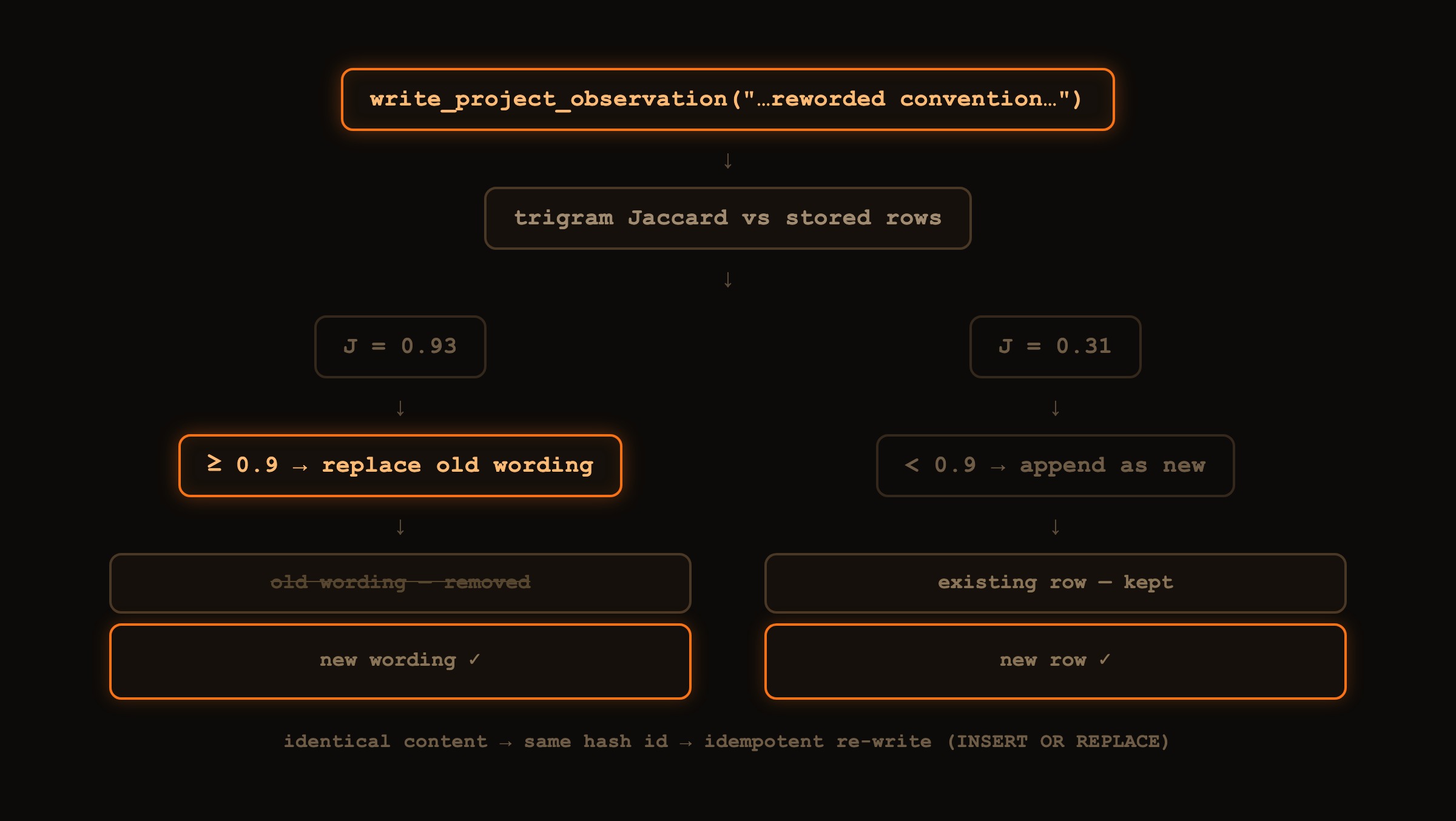
The write side gets the same treatment. Years of near-identical rewordings bury signal under echo, so every write runs a cheap trigram-similarity check: ≥ 0.9 Jaccard → the old wording is replaced; below that, appended. Identical content still maps to the same id, so re-writes stay idempotent. One honest trade-off: a rewording gets a new id, so previously shared ids may become unresolvable — a memory that deduplicates is worth more than one where stale ids live forever.
Takeaways if you're building agent memory
- Substring search is the wrong default for natural-language queries; an AND-of-terms match is the floor.
- FTS5 trigram gives substring semantics plus bm25 with zero infrastructure — it's in the SQLite you already ship.
- Always rank. Recency-only ordering trains the agent to ignore the tool.
- Gate your fallbacks. Thresholds (0.2 per token, 0.3 mean, 0.9 dedup) make tolerance precise instead of fuzzy.
- Deduplicate at write time. Not polluting memory is cheaper than cleaning it.
A few hundred lines, one virtual table, one scoring function — and it's the difference between a memory the agent distrusts and one it checks before every edit.